Search This Blog

Showing posts with label Cell phones hack. Show all posts

Wednesday, May 18, 2011

A breakout board for your Android phone

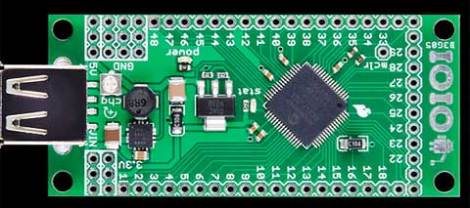
[sparkfun] announced a new board called the IOIO (pronounced “yo-yo”) this week that allows communication from your Android devices to your upcoming projects.
The board hasn’t been released yet; [sparkfun] is still pulling together documentation and waiting on their first production run. We do know that the board contains a PIC24F MCU, and will give your phone analog input,  and Digital I/O, PWM, I2C, SPI, and UART control. Communication with the board is over the USB port on your phone.
The brilliant thing about this board is that an external programmer isn’t required. Everything you connect to this board can be controlled from within Android apps. We covered Android development in a hackaday tutorial series before, so now it’s possible to put these skills to give your projects a touch screen, internet and bluetooth connections, a camera, or your phone’s accelerometers. Very slick.
Video of some basic functions demonstrating what possible with this board after the jump, but feel free to comment and tell us what you’d like to see done with this board.

Real-time GPS tracker with mobile phone uplink


 wasn’t actually trying to solve any clever problems when we built his homebrew GPS tracker. He just had the hacker mentality and wanted to build something fun and useful while geeking out with electronics and software.
On the hardware side, he started with an Arduino, then added a GPS module for location detection and a GMS/GPRS module for the data uplink to his server over AT&T’s network. The Arduino uses several libraries and plenty of custom code. On the server, he worked up some wizardry with open-source packages and the Google Maps API. All of the source code and hardware details are well-documented. Put together, it’s a GPS tracker that can update a map in real-time. Sure, there are commercial products that do roughly the same thing, but where’s the fun in that? The principles here can also be put to good use in other microcontroller-based projects

GSM-to-Skype bridge lets you lose those roaming fees


Here’s the scenario: you’re going to be traveling somewhere and you’ll be charged roaming fees if you use your cellphone. But there is free WiFi available in this place. You can save yourself money by leaving your SIM card at home and using a GSM-to-Skype bridge to take calls on your phone via WiFi.
[Trax] is using a USB GSM modem to take cellphone calls on a PC. He leaves his sim card in this modem so that it can make and receive calls and text messages through your normal telephone number. For some reason, the USB connection only provides control of this modem and doesn’t pass bi-directional audio. To make this happen, he built an audio interface cable using two transformers and a few passive components to connect the modem to the computer’s audio card.
On the software side of things, an application written in Delphi 7 manages the modem, the audio stream, and the Skype application. When a call is incoming it sets up a Skype connection with your handset via the Internet, passing along the caller ID data in the process. If you choose to answer the Skype session the application will pick up the GSM call and you’ll be connected. It works the same way when placing an outgoing call.
This seems easier to manage than a rig that physically pushes a cellphone’s buttons via the Internet.